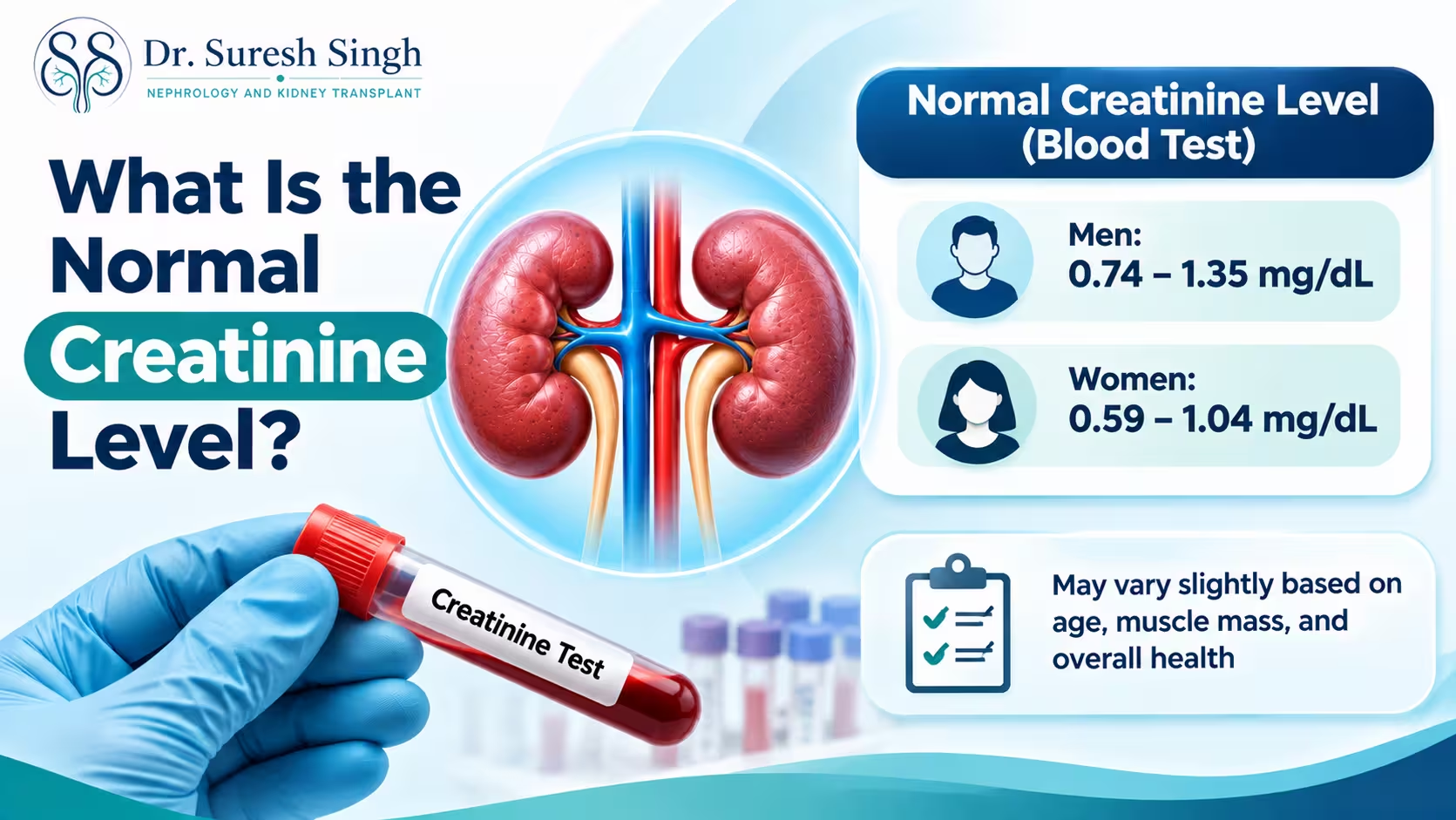
The normal blood (serum) creatinine range varies depending on a person's sex, age, and muscle mass. In adult males, it typically ranges from 0.7 to 1.2 mg/dL (or 0.6 to 1.2 mg/dL, depending on the laboratory), while in adult females, it generally ranges from 0.5 to 1.0 mg/dL (or up to 1.1 mg/dL). For children aged 0–18 years, the normal range is approximately 0.2 to 1.0 mg/dL. In older adults aged 60 and above, creatinine levels may vary slightly due to age-related changes in muscle mass.
What Is Creatinine?
Creatinine is the metabolic waste product produced by the body's muscles. It is produced by the body on an ongoing basis while muscles metabolize energy. Creatinine passes into the bloodstream and gets removed by the kidneys via urine.
Having a certain quantity of creatinine in the blood is quite natural. Since kidneys eliminate creatinine constantly, the level of creatinine remains stable.
If kidneys do not filter the blood efficiently, creatinine starts accumulating. As a result, the level of creatinine might become abnormally high.
To identify the level of creatinine in the blood, doctors conduct a serum creatinine blood test. Such a test is commonly prescribed to those people whose kidney health needs to be assessed.
What Is the Normal Creatinine Range in Adults?
For most adults, the commonly used reference ranges are:
|
Person |
Usual blood creatinine range |
|
Adult men |
0.7–1.3 mg/dL |
|
Adult women |
0.5–1.1 mg/dL |
This is an approximate range and not a hard limit in everyone’s case. The laboratories might have slight variations in values, and hence the value range specified on your lab test report is relevant too.
This variation between males and females can be attributed to muscle strength. A person who has more muscles will have higher creatinine levels than someone with fewer muscles, provided that the functioning of their kidney is normal.
Thus, a person’s creatinine level should not necessarily be the same as another’s.
Normal Creatinine Levels by Age: What Should You Know?
People often look for a separate creatinine chart for every age group. But there is no single adult chart that can tell whether everyone's result is normal.
Age affects creatinine mainly because muscle size and body build change over time. Children usually have lower levels than adults because they have less muscle. Their expected range also changes as they grow.
|
Age group |
What to know about creatinine |
|
Babies and young children |
Usually lower than adult levels. The expected range changes as the child grows. |
|
Older children and teenagers |
Levels rise with growth and muscle development. |
|
Younger adults |
Muscle size and sex have a strong influence on the result. |
|
Middle-aged adults |
The same general adult reference ranges are often used, but the result must be read with eGFR. |
|
Older adults |
Lower muscle mass can keep creatinine looking normal even when kidney function has fallen. |
Age-appropriate laboratory parameters should be used in children. In adults, there is no separate creatinine cut-off for each decade of life.
There is only one thing to note in elderly patients. With aging, the amount of muscle mass decreases; hence, the production of creatinine might be reduced. This leads to decreased function of the kidneys even if the patient's creatinine is not that high.
This is one of the reasons why the state of kidneys cannot be assessed using age and creatinine only.
Does a Normal Creatinine Level Mean the Kidneys Are Healthy?
Not always.
A patient may have early stages of kidney disease even when his creatinine level is within the normal range as provided by the laboratory. This is because even at this stage, the kidneys might be filtering adequate amounts of waste to prevent any increase in the amount of blood creatinine.
Doctors use another figure known as eGFR (estimated glomerular filtration rate) to estimate the ability of the kidneys to filter wastes from the body. Creatinine is used in the estimation along with other factors like age and gender.
A urine test will be required to detect albumin, which is a form of protein. Leakage of albumin in urine may be an indication of kidney damage.
For a clearer picture, doctors may consider:
-
Serum creatinine
-
eGFR
-
Urine albumin-to-creatinine ratio (uACR)
-
Blood pressure
-
Other blood and urine test results
Looking at these results together gives more useful information than checking creatinine alone.
What Can Cause Creatinine Levels to Rise?
A high creatinine result can point towards a kidney problem, but the kidneys are not the only possible reason for the increase.
Some causes include:
-
Kidney disease: The buildup of creatinine in the blood can occur due to reduced functionality of the kidneys.
-
Dehydration: This condition can reduce the blood flow to the kidneys and increase creatinine levels if you experience excessive fluid loss due to vomiting, diarrhea, sweating, or dehydration.
-
Physical exertion: Intense physical activity can have an effect on creatinine levels, especially following muscle exertion.
-
Consumption of a large portion of cooked meat: The intake of such a meal shortly before the test can cause a temporary spike in the results.
-
Muscle damage: Damage to muscle tissue can lead to increased creatinine levels in the blood.
-
Medications: Some medications can alter the process of testing the kidneys. Do not stop the use of the prescribed medications based on the test results.
A doctor may ask about recent exercise, food, medicines and illness before deciding what the result means.
What Does a Low Creatinine Level Mean?
Low creatinine levels are often related to low muscle mass, and not a kidney disease.
It might occur in elderly patients with decreased muscle mass, people with low body weight, or patients with prolonged illnesses that resulted in loss of muscle mass. Some liver diseases may cause the reduction of creatinine levels.
Low creatinine level is not usually treated alone. The doctor takes into consideration patient’s general health state, diet, muscle condition, and other laboratory test results.
What Should You Do if Your Creatinine Is High?
First, do not judge the result by the number alone. A small rise may need a repeat test, while a sudden or significant increase may need prompt medical attention.
The doctor may:
-
Repeat the blood test to see whether the level is still high.
-
Check eGFR to estimate kidney function.
-
Ask for a urine test to look for protein or blood.
-
Review medicines, supplements and recent illness.
-
Check blood pressure and blood sugar.
-
Suggest an ultrasound or other tests if a blockage or another kidney problem is suspected.
If creatinine has increased suddenly, especially with very little urine, swelling, vomiting or breathlessness, seek medical advice promptly. Do not try to bring the number down by drinking excessive water or stopping medicines without guidance.
Can You Keep Your Creatinine Level Healthy?
There is no food, drink or home remedy that can guarantee a normal creatinine result. The aim is to protect kidney health and deal with problems that may be affecting kidney function.
A few everyday steps can help:
-
Keep blood pressure under control.
-
Manage blood sugar if you have diabetes.
-
Drink enough water, unless your doctor has advised a fluid limit.
-
Avoid frequent use of painkillers without medical advice.
-
Do not take bodybuilding supplements or creatine products without discussing them with a doctor.
-
Get kidney tests if you have diabetes, high blood pressure or a known kidney condition.
If you already have kidney disease, follow the food and fluid advice given by your doctor. A diet that suits one person may not suit another.
Understanding Your Creatinine Results With a Kidney Specialist
A creatinine result should not be interpreted in isolation. The number needs to be compared with your previous reports and assessed along with eGFR, urine protein, symptoms, medical conditions, and other test results.
Dr. Suresh Singh, Nephrologist in Lucknow, provides specialist evaluation and management for kidney-related conditions, including abnormal creatinine levels, Chronic Kidney Disease (CKD), Acute Kidney Injury (AKI), kidney failure, and other kidney disorders. A proper evaluation can help identify the possible cause of abnormal kidney test results and determine the appropriate next steps based on the individual's condition.
Related Treatments
Conclusion
A creatinine test helps diagnose kidney disease; however, it cannot provide the complete picture by itself. The patient’s age, body mass, eGFR value, and urinalysis results must be considered during the evaluation of kidney function. Sometimes, the results falling within the normal range should be investigated even more because of other symptoms suggesting kidney damage.
Dr. Suresh Singh is a Consultant Nephrologist & Kidney Transplant Physician in Lucknow, India, who possesses over 5 years of experience in kidney treatment. Patients with an abnormal creatinine test result can contact a kidney doctor to interpret the test results.
Frequently Asked Questions
1. Is a creatinine concentration of 1.2 mg/dL normal?
This may fall within the common range for many people. Nevertheless, this depends on the patient's age, gender, muscle mass, eGFR, and additional tests.
2. Can creatinine levels vary between different blood tests?
Yes, this can happen due to various factors, including hydration, physical activity, eating, and drug intake. Sometimes, a physician may recommend doing the test again due to unusual variation.
3. What is a dangerous level of creatinine?
There is no such specific value of creatinine that is considered to be dangerous for all patients. However, a sudden increase is more dangerous than a chronic one.
4. Will drinking more water reduce creatinine?
The problem could be solved by fixing the cause of dehydration, but no amount of extra fluid consumption will improve any damage that was done to the kidneys. People who have restricted fluid intake must not consume additional amounts of water.
5. At what frequency should creatinine levels be tested?
People who suffer from diabetes or hypertension should undergo tests regularly. This should be determined by their condition and the results. The frequency of testing can be recommended by the physician.